

The past two years have been confusing for founders.
AI companies are raising massive rounds at eye watering valuations. Meanwhile, strong SaaS, enterprise, and non AI startups are struggling to get meetings.
So what is actually happening?
In a recent conversation Nathan Beckord, CEO of Foundersuite and Fundingstack, broke down what he is seeing across thousands of startups actively raising capital.
The picture is nuanced. It is not that capital disappeared. It shifted.
Here is what founders should understand about the current market and how to position themselves for what comes next.
1. The Market Is Not Frozen. It Is Narrow.
It feels like capital dried up because for most startups, it did.
Outside of AI, 2025 and the first part of 2026 has been a difficult fundraising period. Many solid enterprise and SaaS founders are facing slower processes, more diligence, and more rejections.
But in AI, capital is flowing aggressively.
This creates a distorted perception. The market is not broadly booming. It is concentrated.
For founders, this means two things:
- If you are building in AI, expect competition and hype but also capital availability.
- If you are not, you must be exceptionally clear on traction, efficiency, and differentiation.
The days of raising on narrative alone are gone (for now).
2. Funding Cycles Are Normal
Nathan has lived through multiple startup cycles in San Francisco. The dotcom boom and crash. The 2008 financial crisis. The pandemic surge. The recent slowdown.
The pattern repeats.
Boom. Overextension. Correction. Rebuild. Boom again.
What is different this time is that the current “bubble” appears more narrow. It is largely AI focused rather than market wide.
That matters.
If one category cools, it does not necessarily drag down the entire startup ecosystem. That gives the broader market a stronger base in 2026 and beyond.
3. 2026 Could Be a Turning Point
From the vantage point of Foundersuite, which supports thousands of startups raising capital, the signal is clear.
2024 & 2025 were tough years.
Both founders and venture funds struggled to raise capital. Emerging managers found it hard to close new funds. Startups found it hard to close rounds.
But there are reasons for optimism:
- A potential thaw in IPO activity
- More family offices entering private markets
- Capital recycling from future AI exits
- Improved macro conditions
When exits return, liquidity returns. When liquidity returns, angels reinvest. When angels reinvest, early stage capital expands.
The ecosystem is cyclical.
Founders who survive the cold cycles are positioned best for the warm ones.
4. Timing Your Leap Into Entrepreneurship
One of the most relatable parts of the conversation was about when to start a company.
Many professionals feel stuck.
You build a strong career. Your income increases. Your lifestyle expands. Then one day you look up and realize that leaving to start something feels impossible.
Nathan described it as a trap. Not a bad life. Just a comfortable one that becomes harder to step away from.
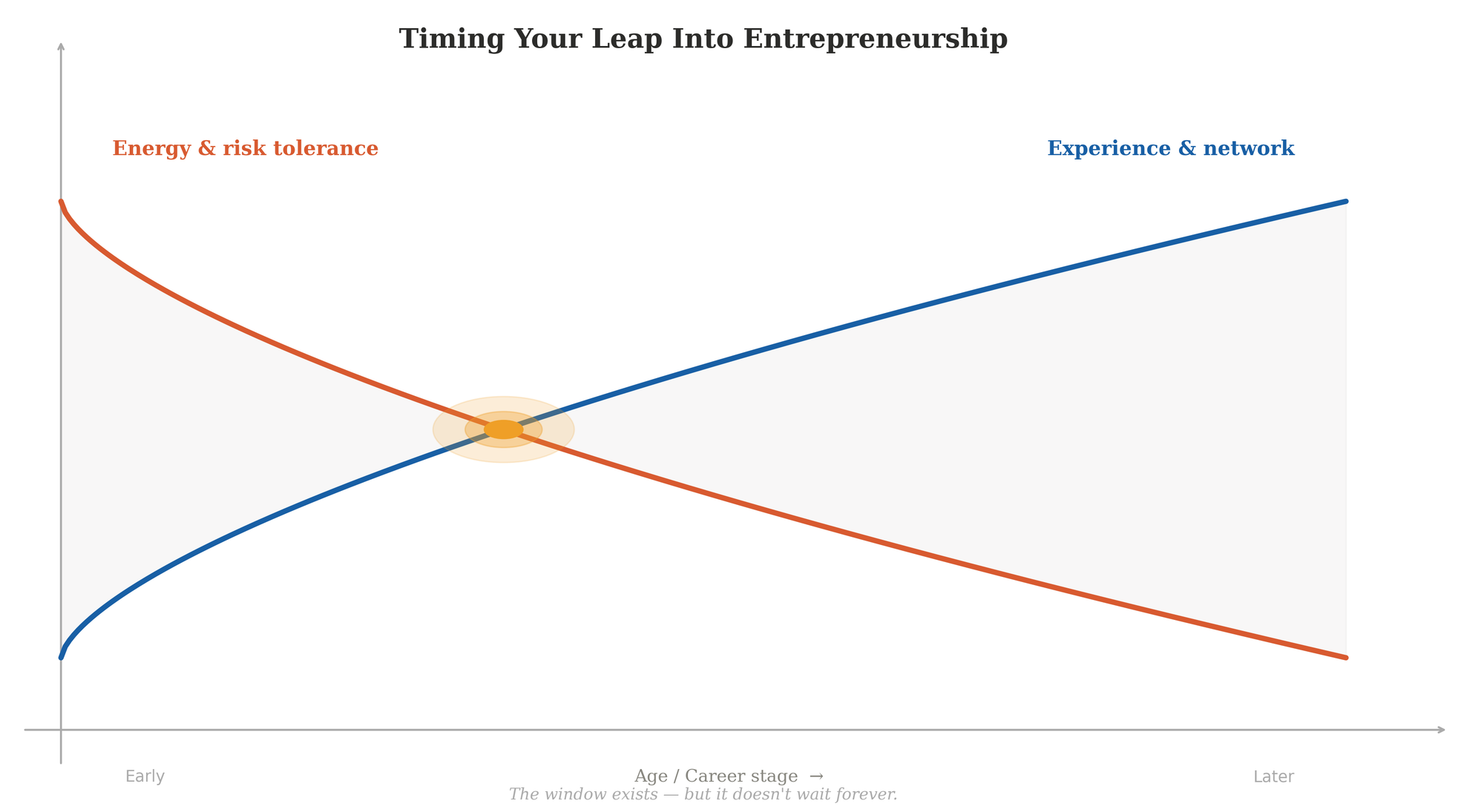
There is a tension between:
- Experience and network, which increase over time
- Energy and risk tolerance, which slowly decline
There is no perfect moment to start a company. Early in your career, you have freedom but a limited network. Later, you have a network but more obligations.
The key insight is simple: if you are waiting to feel completely ready, that moment may never arrive. Take the leap when the opportunity is calling you so strongly you can’t stop thinking about it (obsession is a key trait for successful founders!)
5. Early Stage Focus: The CEO’s Job Is Learning to Say No
One of Nathan’s biggest early mistakes was product sprawl.
Like many founders, he listened to every piece of feedback. Each prospect suggested another feature. Each conversation added one more request.
The product slowly became bloated.
The lesson was simple but powerful: solve one clear problem with a simple product.
Early stage companies often lose when they try to build everything for everyone. Complexity increases burn, slows development, and makes the product harder for customers to understand.
As a founder, one of the hardest skills to develop is learning to say no.
Customers will request features. Investors will have opinions. Advisors and team members will suggest new opportunities.
But not every idea deserves to make it onto the roadmap.
That means recognizing that:
- Not every feature request is strategic
- Not every investor suggestion aligns with your vision
- Not every market opportunity is worth chasing
Early stage startups win through focus. The CEO’s job is protecting that focus.
6. Geography Matters Less Than It Used To
For years, founders asked one question: do I need to move to Silicon Valley?
Today, the answer is more nuanced.
Silicon Valley remains powerful because of its capital recycling cycle. Successful founders exit, become angels, fund new founders, and repeat the loop.
But remote work changed the equation.
Founders can now build in Nashville, Austin, Estonia, or anywhere with strong talent and internet access.
Capital still clusters. But access to capital is more distributed than ever.
The real differentiator is not location. It is network density and execution.
7. If You Are Raising Now, Think Like a Surfer
Nathan used a metaphor that resonates: the surfer hoping to catch an epic wave.
You cannot wait until the wave arrives to paddle out. You need to already be in the water, ready and well-positioned in the lineup.
In startup terms:
- Keep your company alive.
- Control burn.
- Extend runway.
- Keep building.
- Stay visible to investors.
In short, keep going, even if things are tough right now. When markets turn, they turn quickly.
Founders who are already in motion are the ones who catch the next wave.

8. Why Founder Psychology Matters More Than Ever
Perhaps the most important takeaway from this conversation is psychological.
Startups are emotionally volatile.
You may earn less than your employees some years. You may question your decision to leave a stable career. You may watch entire sectors freeze.
That does not mean you made the wrong call.
It means you are operating inside a cycle.
The founders who win are not always the smartest or the most connected. Often, they are the ones who stayed in the game long enough for conditions to move in their favor.
Final Takeaway for Founders
Capital did not disappear.
It concentrated. It slowed. It became more selective.
But cycles turn.
If you are building right now:
- Stay disciplined.
- Focus on one real pain point.
- Avoid product sprawl.
- Extend the runway.
- Keep relationships warm.
And when the next funding wave builds, be ready.
Because the best time to catch it is not when it is obvious. It is when you see it building on the horizon and are already paddling furiously.