
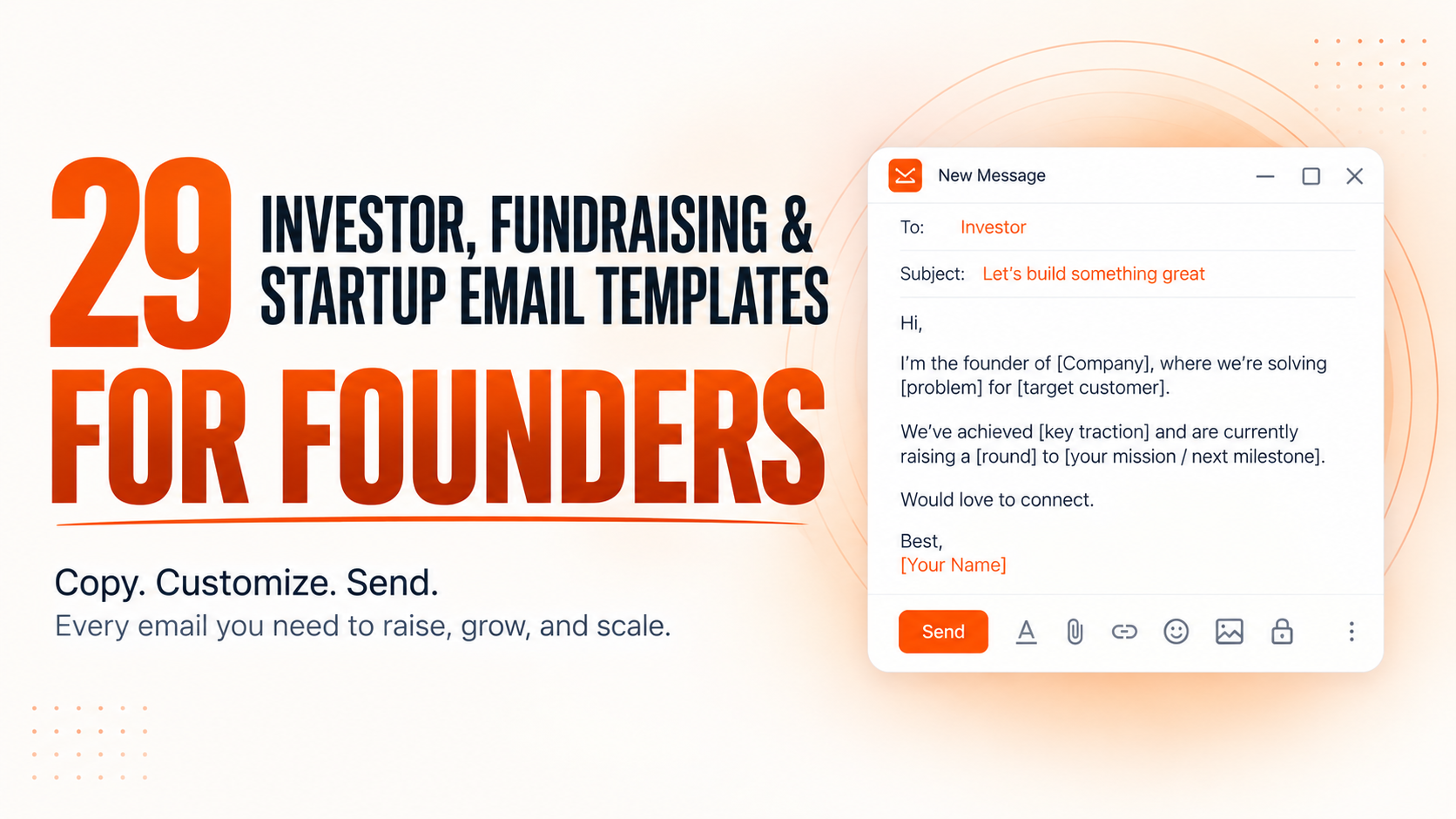
Most founders spend hours writing emails they only need to write once.
Whether you're asking for an investor introduction, following up after a pitch meeting, sending your monthly investor update, or announcing a difficult decision, there are certain emails every founder ends up sending.
This guide brings together 29 of the most common startup and fundraising emails in one place.
They're organized around the different stages of the founder journey—from building relationships before fundraising to running a live raise, communicating with investors after closing, and navigating difficult situations like pivots or bridge rounds.
For each template, we've included:
- When to use it
- Why it works
- A copy-and-paste example
Use these templates as a starting point, not a script. The strongest founder communication is always specific, honest, and backed by real progress.
Let's start with the emails founders should be sending before they raise their first dollar.
📬 PHASE 0: PRE-FUNDRAISING POSITIONING
The best fundraising often starts long before founders actively raise capital.
Before investors write checks, they look for signals:
- founder quality
- market understanding
- customer obsession
- momentum
- relationships
- credibility
This phase focuses on building those signals early.
The goal is not to raise immediately.
The goal is to:
- build relationships
- learn from users
- recruit early supporters
- create trust before fundraising starts
1. Advisor Outreach Email
When to Use This
Use when reaching out to experienced founders, operators, or industry experts for guidance.
Why This Works
Strong advisors:
- accelerate learning
- increase investor confidence
- open doors to customers and investors
- help founders avoid expensive mistakes
The best advisor outreach emails are:
- short
- specific
- respectful of time
Template
Subject: Would love your guidance
Hi [Name],
I've been following your work in [industry/company].
I'm currently building [Company], where we're focused on [problem].
We're still early, but have reached [traction metric]. I'd love to get your perspective as we continue building.
Would you be open to a short conversation sometime next week
Thanks,
[Your Name]
2. Recruiting Angel Advisors
When to Use This
Use when building relationships with experienced angels or operators before fundraising.
Why This Works
Well-connected angels can:
- help shape fundraising strategy
- provide introductions
- validate the company socially
- increase investor confidence
The best relationships are built before money is involved.
Template
Subject: Building in [space]
Hi [Name],
I've been following your work and investments in [industry].
We're currently building [Company], focused on [problem].
Still early, but we've started seeing traction around [metric/customer insight].
Would love to connect and get your perspective as we continue building.
Best,
[Your Name]
📈 PHASE 1: STARTING FUNDRAISING CONVERSATIONS
This phase is about opening investor conversations and building momentum early.
The goal is not to immediately close the round.
The goal is to:
- get meetings
- build investor interest
- create social proof
- establish momentum
- start relationships that can compound over time
The best fundraising outreach is:
- concise
- metrics-driven
- easy to skim
- low-friction
- highly specific
Most investors make decisions quickly about whether to engage further.
Your communication should make that decision easy.
3. Warm Intro Request
When to Use This
Use when asking founders, operators, angels, or advisors to introduce you to an investor.
Why This Works
Warm intros still outperform cold outreach in venture fundraising.
The best intro requests are:
- easy to forward
- concise
- traction-focused
- low-effort for the sender
If someone has to rewrite your email, response rates drop significantly.
Template
Subject: Intro to [Investor Name]?
Hey [Name],
Hope you're doing well.
I'm currently raising a [pre-seed / seed] round for [Company], where we're building [1-line description].
We've grown to [traction metric] and are currently speaking with investors focused on [industry/stage].
Would you feel comfortable introducing us to [Investor Name]?
Forwardable blurb below if helpful:
[2-3 sentence forwardable blurb]
Appreciate it either way.
[Your Name]
4. Cold Investor Outreach
When to Use This
Use when contacting investors without a warm introduction.
Why This Works
Investors optimize for signal density.
They scan quickly for:
- traction
- market
- timing
- founder clarity
- relevance to their thesis
The goal of cold outreach is not to raise money immediately.
The goal is to get a meeting.
Template
Subject: [Company Name] - [traction metric]
Hi [Investor Name],
I'm the founder of [Company], where we're building [1-line description].
Over the past [time period], we've:
- Signed [customers/users]
- Grown [X]% MoM
- Reached [metric]
We're currently raising a [round type] and thought this could be relevant given your investments in [sector/company].
Would love to share more if interesting.
[Your Name]
5. Reconnecting With an Investor
When to Use This
Use when reconnecting with investors you previously spoke to.
Why This Works
Many investors invest only after seeing progress over time.
Consistent execution updates:
- reduce perceived risk
- build confidence
- create familiarity
- reopen conversations naturally
Template
Subject: Quick update since we last spoke
Hi [Name],
Wanted to reconnect since we last spoke a few months ago.
Since then, we've:
- [Traction update]
- [Customer/product milestone]
- [Growth metric]
We're now beginning conversations for our next round and thought it made sense to reconnect.
Happy to share more if helpful.
[Your Name]
6. Asking Existing Investors for Intros
When to Use This
Use during an active raise when existing investors can help expand the pipeline.
Why This Works
Investors trust other investors.
Warm investor-to-investor intros:
- increase response rates
- create credibility
- accelerate meetings
- improve fundraising efficiency
Template
Subject: Intro request
Hi [Name],
As we continue fundraising, we'd love introductions to investors focused on [sector/stage].
Particularly interested in:
- [Firm/investor]
- [Firm/investor]
Happy to send a forwardable blurb if helpful.
Thanks again for the support.
[Your Name]
7. Investor Relationship Building Before Fundraising
When to Use This
Use before actively raising.
Why This Works
The best fundraising often starts months before the round officially opens.
Relationship-first fundraising:
- lowers cold-start friction
- builds investor familiarity
- creates future leverage
- improves conversion rates later
Template
Subject: Building in [space]
Hi [Name],
I've been following your investments in [sector].
We're currently building [Company], focused on [problem].
Not actively fundraising yet, but would love to connect early and keep you updated as we grow.
Best,
[Your Name]
8. Sending Pitch Deck After Interest
When to Use This
Use after an investor expresses interest or requests more information.
Why This Works
Investors usually review decks quickly.
Your email should:
- provide context
- reinforce traction
- keep momentum moving
- reduce friction
Template
Subject: Deck attached
Hi [Name],
Great connecting earlier.
Attaching the deck here for reference.
A few highlights:
- [Traction point]
- [Growth metric]
- [Market/customer insight]
Happy to answer any questions or schedule time to discuss further.
[Your Name]
9. “We’re Not Raising Yet” Relationship Email
When to Use This
Use when intentionally building investor relationships before fundraising.
Why This Works
Sophisticated founders often start building investor familiarity 6-12 months before a round.
This creates:
- trust
- familiarity
- repeated exposure
- lower fundraising friction later
Template
Subject: Building in [space]
Hi [Name],
I've been following your work in [industry/sector].
We're currently building [Company], focused on [problem].
Still early, but we've started seeing traction around [metric/customer insight].
Not raising at the moment, but would love to stay in touch and share progress as we grow.
Best,
[Your Name]
⚡ PHASE 2: MANAGING A LIVE FUNDRAISING PROCESS
Once fundraising conversations begin, communication becomes operational leverage.
At this stage, founders are:
- managing momentum
- compressing timelines
- handling investor psychology
- coordinating diligence
- maintaining urgency
- driving the process forward
Strong fundraising processes feel:
- fast
- organized
- high-signal
- competitive
- investor-ready
Weak processes feel:
- reactive
- slow
- disorganized
- uncertain
This phase focuses on communication that helps founders run efficient fundraising processes.
10. Investor Follow-Up (No Response)
When to Use This
Use 5-7 days after sending an outreach email or after an investor goes silent.
Why This Works
Investors miss emails constantly.
Short follow-ups:
- resurface conversations
- maintain momentum
- create additional touchpoints
- often outperform the original outreach
The best follow-ups add new information.
Template
Subject: Re: [Previous Subject]
Hi [Name],
Following up in case this got buried.
Since my last email, we've:
- [New customer]
- [Growth update]
- [Product milestone]
Happy to share more if relevant.
[Your Name]
11. Post-Meeting Follow-Up
When to Use This
Use within 24 hours after investor meetings or pitch calls.
Why This Works
Strong follow-ups:
- reinforce momentum
- summarize key points
- clarify next steps
- signal professionalism
Good founders reduce ambiguity after meetings.
Template
Subject: Great speaking today
Hi [Name],
Thanks again for taking the time today.
As discussed:
- [Key point]
- [Key metric]
- [Next step]
Attaching the deck and additional materials below.
Looking forward to continuing the conversation.
[Your Name]
12. Sending a Data Room
When to Use This
Use once an investor begins deeper diligence.
Why This Works
A clean data room signals:
- operational maturity
- preparation
- trustworthiness
- fundraising readiness
Disorganized diligence slows deals.
Template
Subject: Diligence materials
Hi [Name],
Sharing our data room below:
[Link]
Included:
- Financial model
- Cap table
- Product metrics
- Legal documents
- Customer references
Happy to provide anything else helpful.
[Your Name]
13. Sharing Mid-Round Traction Updates
When to Use This
Use during an active raise when new milestones happen.
Why This Works
Fundraising momentum increases when investors see:
- continued execution
- growing traction
- accelerating demand
- visible progress
Updates create urgency naturally.
Template
Subject: Quick fundraising update
Hi [Name],
Quick update since we last spoke:
- Revenue grew from $X to $Y
- Signed [customer]
- Released [feature]
- Grew [metric] by [X]%
We're continuing investor conversations this week and wanted to keep you updated.
[Your Name]
14. Creating Urgency During a Round
When to Use This
Use when the round is filling and momentum is increasing.
Why This Works
Investors are highly sensitive to:
- social proof
- scarcity
- competitive dynamics
- perceived momentum
Strong founders create urgency honestly, not artificially.
Template
Subject: Round update
Hi [Name],
Quick update on the round:
We've now allocated [X]% of the round and are planning to finalize commitments by [date].
Since we last spoke:
- [New traction]
- [Customer/investor update]
Let me know if you'd like to continue the conversation.
[Your Name]
15. Soft-Circle Confirmation
When to Use This
Use when confirming likely participation before officially closing allocations.
Why This Works
Soft-circles:
- improve fundraising predictability
- help plan allocation
- create psychological commitment
- clarify investor intent
This helps founders understand round dynamics early.
Template
Subject: Confirming participation
Hi [Name],
Wanted to confirm whether we should reserve allocation for your participation in the round.
Happy to answer any remaining questions.
Best,
[Your Name]
</aside>
16. Closing Logistics Email
When to Use This
Use once investors commit and legal closing begins.
Why This Works
Good closing communication:
- reduces operational friction
- accelerates wire timing
- keeps closing organized
- signals professionalism
The final stage of fundraising should feel smooth and coordinated.
Template
Subject: Closing details
Hi [Name],
Excited to have you joining the round.
Sharing wiring instructions and closing documents below:
[Link]
Please let us know once the wire has been sent.
Thanks again.
[Your Name]
17. Investor Ghosting Recovery
When to Use This
Use when an investor stops responding during the process.
Why This Works
Ghosting is common during fundraising.
Short, low-pressure follow-ups:
- close loops cleanly
- reopen conversations occasionally
- maintain professionalism
- reduce ambiguity
Template
Subject: Quick follow-up
Hi [Name],
Totally understand timing gets busy.
Wanted to close the loop on whether this is still something you're evaluating.
Happy to reconnect if helpful.
Best,
[Your Name]
18. Extending the Round
When to Use This
Use when extending fundraising beyond the original timeline.
Why This Works
Extensions happen frequently.
Clear communication:
- maintains trust
- controls narrative
- reduces uncertainty
- keeps investors aligned
Template
Subject: Fundraising update
Hi [Name],
Quick update on the round:
Given continued investor interest and recent momentum, we're extending the round slightly to finalize conversations with a few additional investors.
Since we last spoke:
- [New milestone]
- [Growth update]
Happy to share additional details if helpful.
[Your Name]
📊 PHASE 3: POST-FUNDING INVESTOR MANAGEMENT
Fundraising does not end when the round closes.
In many ways, investor communication becomes more important after the money is raised.
Strong post-funding communication:
- builds long-term investor trust
- increases support from existing investors
- improves future fundraising odds
- creates accountability
- strengthens company reputation
Weak investor communication creates:
- uncertainty
- loss of confidence
- reduced investor engagement
- weaker future fundraising leverage
The best founders treat investor updates as a strategic advantage, not an obligation.
Many future rounds begin with updates sent months or years earlier.
19. Monthly Investor Update
When to Use This
Use monthly or quarterly to keep investors and supporters informed.
Why This Works
Consistent updates:
- compound investor trust
- create accountability
- surface helpful introductions
- maintain long-term fundraising leverage
Investors are more likely to help founders who communicate consistently.
Recommended Structure
- Metrics
- Wins
- Challenges
- Hiring
- Asks
Template
Subject: [Company] Investor Update - [Month]
Hi everyone,
Quick update from [Company].
Key Metrics
- Revenue: $X (+Y% MoM)
- Users/customers: X
- Burn: X months runway
Wins
- [Major milestone]
- [Product/customer growth]
Challenges
- [Current bottleneck]
- [Operational issue]
Hiring
- Hiring for [role]
Asks
- Intros to [customer type]
- Candidates for [role]
Thanks again for the support.
[Your Name]
20. Quarterly Deep-Dive Update
When to Use This
Use for:
- lead investors
- board communication
- strategic company updates
- major planning cycles
Why This Works
Longer strategic updates help investors understand:
- company direction
- market positioning
- operational progress
- major risks and opportunities
This is especially useful after meaningful milestones or strategic shifts.
Template
Subject: [Company] Quarterly Update - Q[ ]
Hi everyone,
Wanted to share a deeper update on how things are progressing at [Company].
Company Progress
This quarter we:
- Grew [key metric] from [X] to [Y]
- Reached [milestone]
- Signed/launched [customer/product update]
Product
Key product developments:
- [Launch/update]
- [Improvement]
- [Roadmap progress]
What we’re learning:
- [Customer insight]
- [Market insight]
Financial & Growth
- Revenue: $X
- Growth: X% QoQ
- Runway: X months
- Burn: $X/month
Hiring & Team
This quarter we:
- Hired [role]
- Expanded [team/function]
- Are currently hiring for [role]
Challenges
Areas we’re actively working through:
- [Challenge]
- [Challenge]
Current focus:
- [Priority]
- [Priority]
Looking Ahead
Over the next quarter, our priorities are:
- [Goal]
- [Goal]
- [Goal]
Appreciate all the continued support and introductions along the way.
Please reach out anytime with thoughts, feedback, or questions.
[Your Name]
21. Major Win Announcement
When to Use This
Use after:
- major customer wins
- fundraising milestones
- product launches
- partnerships
- revenue milestones
Why This Works
Big milestone updates:
- reinforce momentum
- increase investor confidence
- create positive energy around the company
- strengthen future fundraising narratives
Strong founders celebrate progress without sounding overhyped.
Template
Subject: Big milestone for [Company]
Hi everyone,
Wanted to share a major milestone:
[Customer/revenue/product achievement]
Huge thanks for all the support along the way.
Excited for what's ahead.
[Your Name]
22. Bad News / Missed Targets Update
When to Use This
Use when:
- growth slows
- targets are missed
- launches are delayed
- churn increases
- runway becomes tighter
Why This Works
Great founders communicate difficult news early.
Investors lose confidence faster when:
- problems are hidden
- surprises appear late
- communication disappears
Transparency builds long-term trust.
Template
Subject: Update on quarterly goals
Hi everyone,
We fell short of our original targets this quarter.
Primary reasons:
- [Reason]
- [Reason]
What we're doing now:
- [Action]
- [Action]
Despite the slowdown, we're seeing encouraging signals around [area].
We'll continue sharing updates transparently.
[Your Name]
23. Follow-On Raise Teaser
When to Use This
Use several months before the next fundraising process begins.
Why This Works
Sophisticated founders begin planting fundraising seeds early.
This creates:
- investor familiarity
- long-term context
- reduced cold-start friction
- future fundraising momentum
Many investors prefer watching execution over time before committing.
Template
Subject: Looking ahead
Hi [Name],
As we continue scaling, we're beginning to think ahead about our next financing later this year.
Would love to keep you updated as we continue growing.
Recent progress:
- [Metric]
- [Customer/product milestone]
Looking forward to staying in touch.
[Your Name]
⚠️ PHASE 4: HIGH-STAKES FOUNDER COMMUNICATIONS
Every startup eventually faces difficult moments.
Missed targets. Pivots. Runway pressure. Founder departures. Delayed launches.
During these moments, communication quality matters even more.
Weak communication creates:
- panic
- confusion
- loss of trust
- damaged investor confidence
- internal uncertainty
Strong communication creates:
- clarity
- alignment
- credibility
- confidence under pressure
The best founders communicate difficult news:
- early
- calmly
- directly
- transparently
This phase focuses on high-trust communication during difficult company moments.
24. Pivot Announcement
When to Use This
Use when changing:
- product direction
- customer segment
- business model
- company strategy
Why This Works
Pivots create uncertainty.
Strong communication helps stakeholders understand:
- why the change is happening
- what was learned
- why the new direction is stronger
Good founders frame pivots around learning, not failure.
Template
Subject: Strategic update
Hi everyone,
Over the past [time period], we've learned that the strongest demand is around [new direction].
As a result, we're shifting focus toward [new strategy].
Why:
- [Insight]
- [Market signal]
- [Customer learning]
We're confident this creates a stronger long-term opportunity.
Will continue sharing progress as we execute.
[Your Name]
25. Bridge Round Outreach
When to Use This
Use when raising interim financing between larger rounds.
Why This Works
Bridge rounds are often sensitive.
Strong communication:
- controls narrative
- reduces uncertainty
- reinforces long-term plan
- explains milestone path clearly
The best bridge conversations feel operational, not desperate.
Template
Subject: Bridge financing update
Hi [Name],
We're currently putting together a small bridge round to extend runway as we hit key milestones around [goal].
Since our last update:
- [Progress]
- [Traction]
- [Operational improvement]
Happy to share additional context and updated metrics if helpful.
[Your Name]
26. Down Round Communication
When to Use This
Use when raising capital below the valuation of the previous round.
Why This Works
Down rounds can create:
- employee anxiety
- investor concern
- morale issues
Strong communication reframes the conversation around:
- survival
- focus
- long-term company durability
Template
Subject: Financing update
Hi everyone,
Given the current market environment and company priorities, we've decided to move forward with a financing structure different from our previous round.
Our focus remains:
- building a durable company
- extending runway responsibly
- continuing execution against key milestones
We appreciate the continued support and belief in the long-term opportunity.
[Your Name]
27. Co-Founder Departure Announcement
When to Use This
Use when a founder leaves the company.
Why This Works
Founder departures create immediate uncertainty.
Strong communication:
- reduces speculation
- maintains confidence
- clarifies operational continuity
- protects company stability
The goal is clarity, not drama.
Template
Subject: Team update
Hi everyone,
I wanted to share that [Name] will be stepping away from [Company].
We're grateful for their contributions and wish them the best moving forward.
Operationally, here's how responsibilities will transition:
- [Responsibility]
- [Responsibility]
We're fully focused on continuing execution and supporting the team through the transition.
[Your Name]
28. Acquisition Interest Response
When to Use This
Use when another company expresses acquisition interest.
Why This Works
Acquisition conversations require careful communication.
Strong founders:
- maintain leverage
- avoid premature signaling
- keep conversations professional
- avoid over-committing emotionally
Template
Subject: Re: Strategic conversation
Hi [Name],
Appreciate the outreach and interest in [Company].
We're currently focused on continuing execution and growth, but would be open to an initial conversation to learn more about what you have in mind.
Happy to coordinate time.
[Your Name]
29. Missed Payroll / Runway Update
When to Use This
Use during severe financial pressure or emergency runway situations.
Why This Works
These moments permanently shape company trust.
Strong founders communicate:
- honestly
- directly
- responsibly
- with clear next steps
Avoiding communication usually worsens the situation dramatically.
Template
Subject: Important company update
Hi team,
I want to communicate transparently about our current financial situation.
We're facing short-term runway pressure and are actively working through financing and operational solutions.
Current priorities:
- [Financing action]
- [Cost action]
- [Operational priority]
We'll continue sharing updates frequently as we navigate this situation.
[Your Name]
📌 Final Thoughts
Great founder communication builds trust, creates momentum, and makes decisions easier.
The best founders communicate consistently with investors, customers, employees, and partners throughout every stage of the startup journey.
We hope this playbook helps founders communicate more clearly and raise capital more effectively.
Built by the team at Foundersuite