

When generative AI entered the mainstream, it felt like every startup pitch suddenly sounded identical. Everyone was using AI. Everyone had a demo. Everyone promised transformation.
According to Max Spero, CEO of Pangram Labs, that sameness is exactly what founders should be worried about.
In a conversation on How I Raised It with Nathan Beckord, Max explains that most AI startups do not fail because the technology does not work. They fail because users do not trust it. Pangram Labs was built around that insight, with a focus on credibility, restraint, and solving the problems AI creates rather than simply showcasing what it can do.
This article breaks down how Pangram approached product strategy, content, and fundraising in one of the most crowded categories in tech and what founders can learn from it.
1. Start With the Problem AI Creates, Not the Trend It Represents
Max and his cofounder both came from deep machine learning backgrounds, with experience at companies like Google and Tesla. When tools like ChatGPT first appeared, they did not immediately rush to build a company around them.
They waited.
The real inflection point came with GPT-4. At that moment, it became clear that AI was not a novelty or a feature. It was infrastructure.
The more important question was not what AI could do, but what problems it would create once it was adopted at scale.
For Pangram, that problem was trust. As AI-generated content flooded classrooms, search engines, and online platforms, people lost the ability to tell what was human and what was synthetic. That ambiguity created real downstream issues in education, media, and online communities.
The founder lesson here is straightforward. Do not chase the trend itself. Identify the second-order problem the trend creates and build for that.
2. Position Your Product as a Guardrail, Not an Enforcement Tool
One of Pangram’s earliest customers was in education. Teachers were suddenly receiving student work that looked unusually polished, but banning AI outright was unrealistic. Students were already using it, and adoption was only increasing.
Max is clear about Pangram’s positioning.
- It is not designed to ban AI
- It is not meant to punish users
- It is not an enforcement mechanism
Instead, Pangram provides clarity. It helps educators understand how AI is being used so they can have better conversations and make informed decisions before jumping to conclusions.
That framing mattered. Products that feel punitive struggle to gain trust. Products that provide context and insight are easier to adopt.
For founders, this is a positioning lesson. The most successful tools do not just enforce rules. They help users navigate new realities more thoughtfully.
3. Cheap Content Creates a Trust Crisis
Education was only the beginning. Pangram quickly saw the same problem spreading across the broader internet.
As AI made content dramatically cheaper to produce, platforms began filling up with low-quality material that looked polished but lacked real insight or experience. This showed up in familiar ways:
- AI-generated reviews on consumer platforms like Amazon
- Low-effort answers flooding forums and Q&A sites such as Medium and Quora
- Spammy, self-promotional content across blogs and communities like Reddit
The issue is not just authenticity. It is scale. When anyone can generate thousands of posts instantly, trust becomes a scarce (and valuable) resource.
For founders building platforms, marketplaces, or content-driven products, this is a warning sign. If trust is not designed into the system, it will erode over time.
4. Use AI to Strengthen Your Voice, Not Replace It
Max is deliberate about how he uses AI in his own work. He does not ask it to write content from scratch.
Instead, his workflow looks like this:
- Record himself talking through an idea in raw form
- Use AI to organize that thinking into clear sections
- Identify themes and structure
- Edit heavily to preserve his own voice and judgment
He also uses AI for research, especially to surface primary sources and technical material. This saves time without outsourcing decision-making.
The takeaway for founders is practical. Let ideas originate from you. Use AI to accelerate, organize, and refine, not to replace your perspective.
5. Why Original Research Beats Content Volume
One of Pangram’s biggest breakthroughs came from publishing original research rather than producing endless marketing content.
Instead of flooding the internet with blog posts, the team focused on technical reports backed by real data. Those reports established credibility not just with customers, but with investors and even large language models themselves.
In an AI-first world, authority matters more than volume. One strong source can outperform thousands of shallow ones.
For founders thinking about content and distribution, this is an important shift. Focus on depth. Not output.
6. Bootstrap First, Then Raise With Proof
Pangram did not raise capital on day one.
Max and his cofounder bootstrapped the company with roughly $60,000 of their own money, supplemented by startup credits. Their focus was validation, not pitching.
They waited to raise until they had:
- Working models with measurable performance
- Early accuracy benchmarks
- A published technical report demonstrating credibility
Only then did they raise a pre-seed round to hire engineers and scale faster.
For founders running a structured raise, having a single place to manage investor outreach, conversations, and follow-ups helps maintain momentum once fundraising begins. Many teams use tools like Foundersuite at this stage to stay organized and focused while continuing to build.
The broader lesson is simple. Early capital is most effective when it accelerates something that already works.
7. What Pangram Had Before Raising
To make this concrete, here is what Pangram focused on before actively fundraising.
Proof Points Pangram Established Pre-Raise
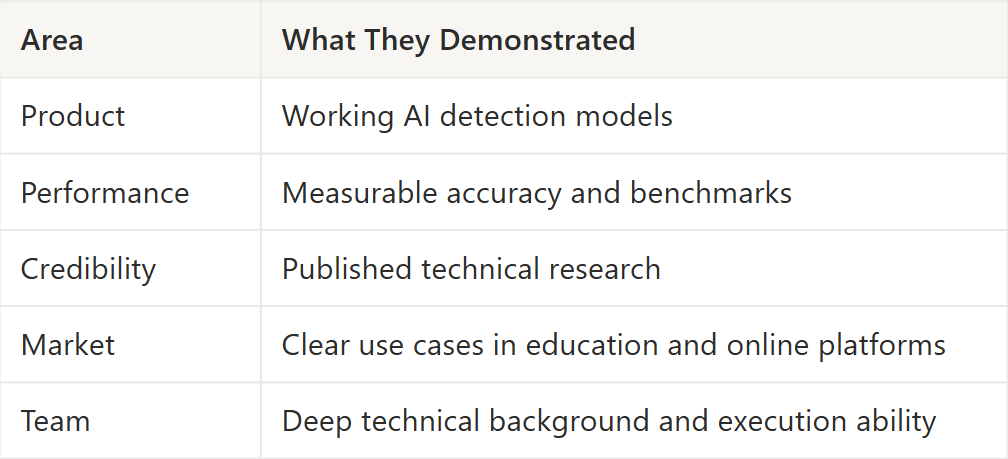
This proof made investor conversations sharper and reduced reliance on hype.
8. Each Fundraising Round Requires a New Story
Max is candid that fundraising did not get easier over time. It got different.
Early investors backed the team and the insight. Later investors asked harder questions about market size, defensibility, and whether AI detection would remain viable as models improved.
Answering those questions required sharper positioning, clearer market math, and stronger proof points.
For founders, the reminder is important. Every round has a higher bar. You cannot reuse the same story forever.
Final Takeaway: Build Trust Before You Scale
Pangram Labs is building in one of the fastest-moving markets in tech, but its advantage is not hype. It is credibility.
The company focused on real problems, thoughtful positioning, original research, and disciplined fundraising. That approach helped them earn trust with customers and investors alike.
For founders working in AI or other emerging categories, Max Spero’s path shows that trust is earned by doing the hard work early, not by leaning on hype.
Nathan Beckord is the CEO of Foundersuite.com and Fundingstack.com, which makes software for raising capital. Foundersuite & Fundingstack combined have helped entrepreneurs and VCs raise over $21 billion since 2016. This article is based on an episode of the How I Raised It podcast, a behind-the-scenes look at how startup founders and fund managers raise money.